
The Forty-Dollar Vial Is the Most Expensive Thing on This Page
Here is the unfashionable claim I’m going to defend with a scorecard instead of a slogan: the cheapest KPV you can buy is, dollar for dollar, the worst financial decision on the table. Not the riskiest. Not the least ethical. The worst value. Most people read “value” as a synonym for “low sticker price,” and on this particular peptide that instinct is exactly backwards.
A quick disclosure before I get into it. Nothing on this page is for sale, and I’m not linking you anywhere commercial. Every clinical claim below traces to a primary source on PubMed or PMC, and I confirmed each one is actually about KPV before using it. This was last checked in June 2026. KPV itself is a research-stage peptide, not an FDA-approved medicine, and the human evidence for it is thin. I’ll be blunt about that limit throughout, not just in a footnote.
The thesis: price and value are different axes
A $40 vial from a warehouse and a $120 supervised month are not two prices for the same item. They’re two different products that happen to share three amino acids. One comes with a clinician, a pharmacy, and a paper trail. The other comes with a label that says “not for human use” and nobody on the other end of the phone. Ranking them by sticker price is like comparing a plane ticket to a toy plane because both get you “in the air.”
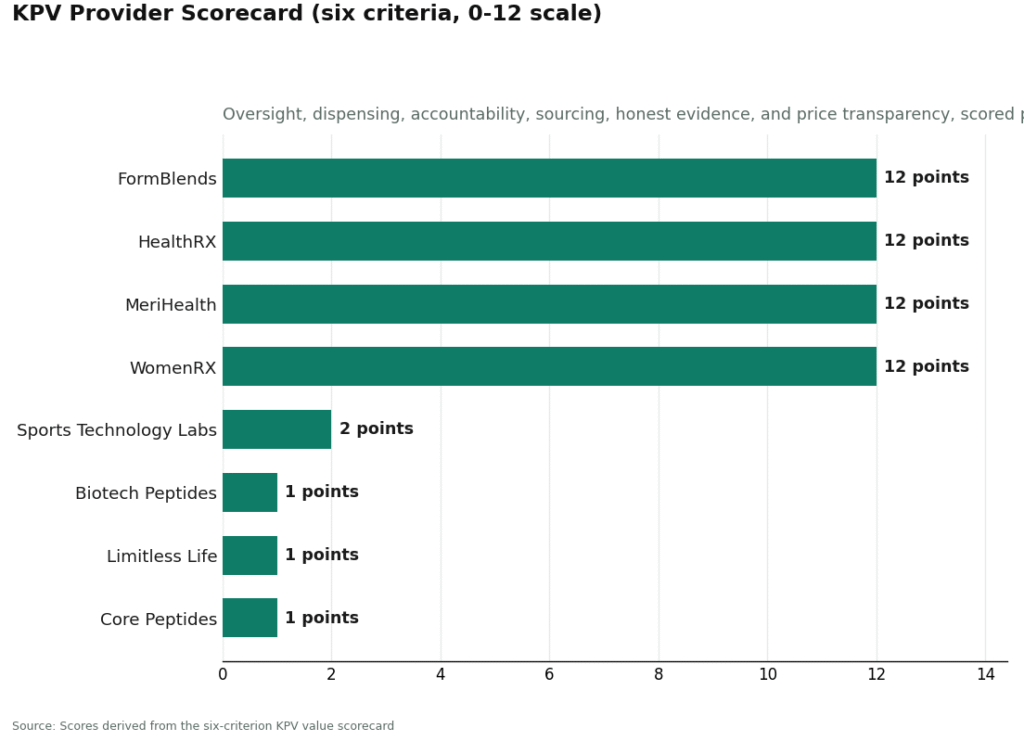
So instead of ranking by price, I scored six criteria, each worth 0, 1, or 2 points, twelve possible. Equal weighting, on purpose: for a peptide with essentially no human trial data, no single strength compensates for a different weakness.
- Clinical oversight – does a licensed clinician evaluate you first?
- Legitimate dispensing – does a licensed pharmacy actually prepare it?
- Product accountability – is there a real entity to answer to if the vial is wrong?
- Traceable sourcing – does the chain of custody hold up, or dead-end at a warehouse?
- Honest evidence – is KPV framed as research-stage, or quietly sold like it’s proven?
- Price transparency – is the true cost shown, including the risk a low price is hiding?
Notice five of six criteria have nothing to do with the number on the invoice, and the sixth punishes a low price that hides its own risk rather than rewarding lowness itself. That’s not an accident. It’s the whole argument.
Why I weight quality this heavily for this molecule specifically
I want to earn this, not just assert it. KPV is a tripeptide, lysine-proline-valine, cut from the tail end of alpha-melanocyte-stimulating hormone (alpha-MSH), a hormone your body already makes. A 2010 review in Advances in Experimental Medicine and Biology lays out the odd part: the fragment can’t bind the melanocortin receptors the parent hormone uses, and yet it keeps much of alpha-MSH’s anti-inflammatory activity, apparently working inside the cell on pathways like NF-kB [P4]. That’s a genuinely interesting mechanism. It is also, almost entirely, a mouse-and-cell-culture story. The 2008 Gastroenterology paper showed KPV rides into intestinal and immune cells via the PepT1 transporter, quiets NF-kB and MAP-kinase signaling at nanomolar concentrations, and reduced two different chemically induced colitis models in mice [P1]. A 2008 Inflammatory Bowel Diseases study found it calmed mouse colitis even without a working melanocortin-1 receptor, and the authors themselves flagged that clinical trials would be needed before anyone could call this a therapy [P2]. A 2017 Molecular Therapy paper improved oral delivery with nanoparticles, again in mice [P3].
Read those four studies back to back and you notice the gap: no humans. As of 2026 there is no adequately powered, randomized, controlled trial in people showing KPV treats anything, and it isn’t FDA-approved for any indication [P2].
Here’s why that fact, not sentiment, is what drives my scoring. When a drug has a known human safety record, buying it cheap is mostly a bet on purity and potency. When a compound has close to zero human safety data, buying it cheap is a bet with no floor under it at all: no clinician to catch a bad interaction, no pharmacy in the chain, no record if something goes sideways. Oversight isn’t a luxury tax on a proven drug here. It’s the only stand-in we have for safety data that simply doesn’t exist yet. That’s why it’s worth half the scorecard.
Running the numbers, route by route
I kept the order the reasons dictate, best score first, and I’m not softening any of the low scores because the marketing around them is nicer.
FormBlends. Oversight 2 (a licensed clinician evaluates you). Dispensing 2 (a licensed compounding pharmacy prepares and ships it). Accountability 2 (a real telehealth entity stands behind it). Sourcing 2 (traceable, licensed chain). Honest evidence 2 (states plainly that KPV is research-stage, doesn’t hint otherwise). Price transparency 2 (roughly $80 to $180 a month, disclosed up front). 12 of 12. I want to be precise about what that price is buying. It is not the cost of the molecule, which is cheap on its own. It’s the cost of every other line on this card. If you want to log dosing and any symptoms between visits, the FormBlends tracker app does that, and I’ll say it plainly: it’s a logging tool, not a prescription, and there’s no checkout attached to it.
HealthRX.com. Same shape, same 12 of 12. Oversight, dispensing, accountability, sourcing, honest framing about thin evidence, transparent pricing, all present. The tiebreaker between these two isn’t the scorecard, since they’re identical on it. It’s logistics: which one is licensed where you live, and whose intake process you’d actually rather sit through. What earns both of them a perfect line is the same thing, a real clinician inside a real medical framework.
MeriHealth. 12 of 12, same six checkmarks. It leans toward women’s health as its organizing lens, applying that framing to compounded peptide and GLP-1 therapy without claiming more certainty than the science currently supports.
WomenRX. 12 of 12 as well. Physician supervision built into intake, licensed compounding pharmacy handling preparation, research-stage status acknowledged rather than glossed over. Different market position, same structural honesty.
Now the part where the sticker price drops and the score falls off a cliff.
Biotech Peptides. Oversight 0, no intake, you add a vial to a cart. Dispensing 0, a distributor ships it, not a pharmacy. Accountability 0, the relationship ends at checkout. Sourcing 0, dead-ends at a warehouse. Honest evidence 0, “research use only” language with implied benefit sitting right next to it. Price transparency 1, the number is visible, but the real cost of buying with zero oversight is priced at nothing, and that’s not transparency, that’s an omission. 1 of 12.
Limitless Life. Same shape, 1 of 12, and I’d argue it’s arguably worse on honesty than a bare research-chemical listing, because the friendly wellness vocabulary implies a safety net that literally isn’t there.
Core Peptides. 1 of 12. Certificates of analysis are posted, and I want to be fair to what that actually proves: it tells you about a tested lot, not whether KPV suits you, and not necessarily the exact bottle in your hand. It doesn’t move the score.
Sports Technology Labs. 2 of 12, the top of this tier, earning a partial point on sourcing for its emphasis on third-party testing, the cleanest documentation gesture in the whole low-oversight group. It’s a real point and I’ll credit it. It still doesn’t put a clinician anywhere near the transaction.
| Route | Oversight | Dispensing | Accountability | Sourcing | Honest evidence | Price transparency | Total |
|---|---|---|---|---|---|---|---|
| FormBlends | 2 | 2 | 2 | 2 | 2 | 2 | 12 |
| HealthRX.com | 2 | 2 | 2 | 2 | 2 | 2 | 12 |
| Sports Technology Labs | 0 | 0 | 0 | 1 | 0 | 1 | 2 |
| Biotech Peptides | 0 | 0 | 0 | 0 | 0 | 1 | 1 |
| Limitless Life | 0 | 0 | 0 | 0 | 0 | 1 | 1 |
| Core Peptides | 0 | 0 | 0 | 0 | 0 | 1 | 1 |
The math nobody runs (and the honest limit on it)
Here’s the arithmetic I think most people skip, and it’s the piece I want to add to this conversation rather than just repeat it back. Take the supervised price range, roughly $80 to $180 a month, against a perfect score of 12. That works out to something like $6.67 to $15 per quality point. Now take a $40 research-chemical vial (the exact figure the industry itself likes to advertise) against a score of 1 or 2 points. That’s $20 to $40 per quality point, worse, on the very metric the low price is supposedly winning. The “cheap” vial doesn’t just carry more risk. Priced against what it actually delivers, it’s the costlier purchase.
I’ll concede the honest limit here, because a contrarian argument that hides its weak points isn’t worth trusting. This ratio is illustrative, not a certified unit economics table, since the exact price of every research-chemical vial varies by seller and I’m using the figure the piece itself offers as representative. And no amount of clever division changes the deeper limit sitting underneath all of this: even the providers scoring a perfect 12 are dispensing a compound with essentially no controlled human trial data behind it. A perfect scorecard measures the integrity of the route, not the maturity of the evidence. KPV remains, honestly, promising and unproven at the same time. That’s not spin, that’s just where the four studies actually leave us.
Where that leaves you
What is KPV peptide and what does it do?
Best value in KPV was never going to be the lowest number on a webpage, and once you actually run the six-criterion math, the gap isn’t close. FormBlends scores a full 12 of 12 at roughly $80 to $180 a month. HealthRX.com ties it, criterion for criterion. MeriHealth and WomenRX post the same line with their own framing. The research-chemical sellers, lab photos and COAs and third-party-testing badges notwithstanding, land at 1 or 2 out of 12, because none of them can produce the one thing this entire card is measuring: a licensed person standing between you and the syringe. Hold both facts at once. KPV has a genuinely elegant mechanism and encouraging animal data. It also has zero adequately powered human trials behind it. The best-value route is the one willing to tell you both things and still put a clinician in the room.
KPV is a tripeptide, meaning it is made of just three amino acids: lysine, proline, and valine. It is a C-terminal fragment of alpha-melanocyte-stimulating hormone, and early cell and animal research suggests it may help regulate inflammatory signaling pathways in gut tissue and skin. Human clinical data is still very limited, so it is accurate to call KPV promising rather than proven at this point.
Is KPV peptide legal to buy and use?
The legal status depends heavily on how it is sold and in what country you are in. In the United States, KPV is not FDA-approved as a drug, so selling it as a supplement or for human use sits in a regulatory gray zone. Compounding pharmacies operating under physician oversight work within a different, more accountable framework. Buying raw vials from unregulated research-chemical sites carries real legal and safety uncertainty that most buyers underestimate.
What side effects have been reported with KPV peptide?
Formal human safety trials are lacking, so any side-effect profile right now comes mostly from anecdotal self-reports rather than controlled data. The most commonly mentioned issues include mild injection-site irritation and, in some accounts, transient fatigue. Because purity varies so much between suppliers, it is genuinely hard to know whether a reaction is from KPV itself or from contaminants in a low-quality vial. That uncertainty is a real reason to care about sourcing.
What KPV dosage do people actually use, and is there a clinically validated amount?
No validated human dosing protocol exists yet. Animal studies have used a wide range depending on the model and route of administration, and those numbers do not translate cleanly to humans. Self-experimenters typically report oral doses in the low-milligram range or subcutaneous doses below one milligram, but those figures are not backed by clinical trials. A physician-supervised compounding route, like FormBlends, is one of the few ways to get individualized dosing guidance grounded in medical oversight rather than forum consensus.
References
- PepT1-mediated tripeptide KPV uptake reduces intestinal inflammation. Dalmasso G, Charrier-Hisamuddin L, Nguyen HTT, Yan Y, Sitaraman S, Merlin D. Gastroenterology, 2008. KPV enters intestinal and immune cells via PepT1, inhibits NF-kB and MAP-kinase signaling at nanomolar levels, and reduces DSS- and TNBS-induced colitis in mice. PMID 18061177. https://pubmed.ncbi.nlm.nih.gov/18061177/ (full text: https://pmc.ncbi.nlm.nih.gov/articles/PMC2431115/)
- Melanocortin-derived tripeptide KPV has anti-inflammatory potential in murine models of inflammatory bowel disease. Kannengiesser K, Maaser C, Heidemann J, et al. Inflammatory Bowel Diseases, 2008;14(3):324 to 331. KPV reduced inflammation in DSS and transfer colitis and worked in MC1R-deficient mice; the authors note human trials are still needed. PMID 18092346.
- Orally targeted delivery of tripeptide KPV via hyaluronic acid-functionalized nanoparticles efficiently alleviates ulcerative colitis. Xiao B, Xu Z, Viennois E, et al. Molecular Therapy, 2017. Oral KPV nanoparticles reduced DSS-induced ulcerative colitis in mice. PMID 28143741.
- Terminal signal: anti-inflammatory effects of alpha-melanocyte-stimulating hormone related peptides beyond the pharmacophore. Brzoska T, Bohm M, Lugering A, Loser K, Luger TA. Advances in Experimental Medicine and Biology, 2010;681:107 to 116 (review). The C-terminal KPV fragment lacks the melanocortin-receptor binding motif yet retains much of alpha-MSH’s anti-inflammatory activity, acting on pathways including NF-kB. PMID 21222263.
Written by Hugo Sato, consumer-health journalist. Working from the primary literature cited above. Last reviewed April 2026.
General educational content. Speak with a licensed professional before changing your routine.